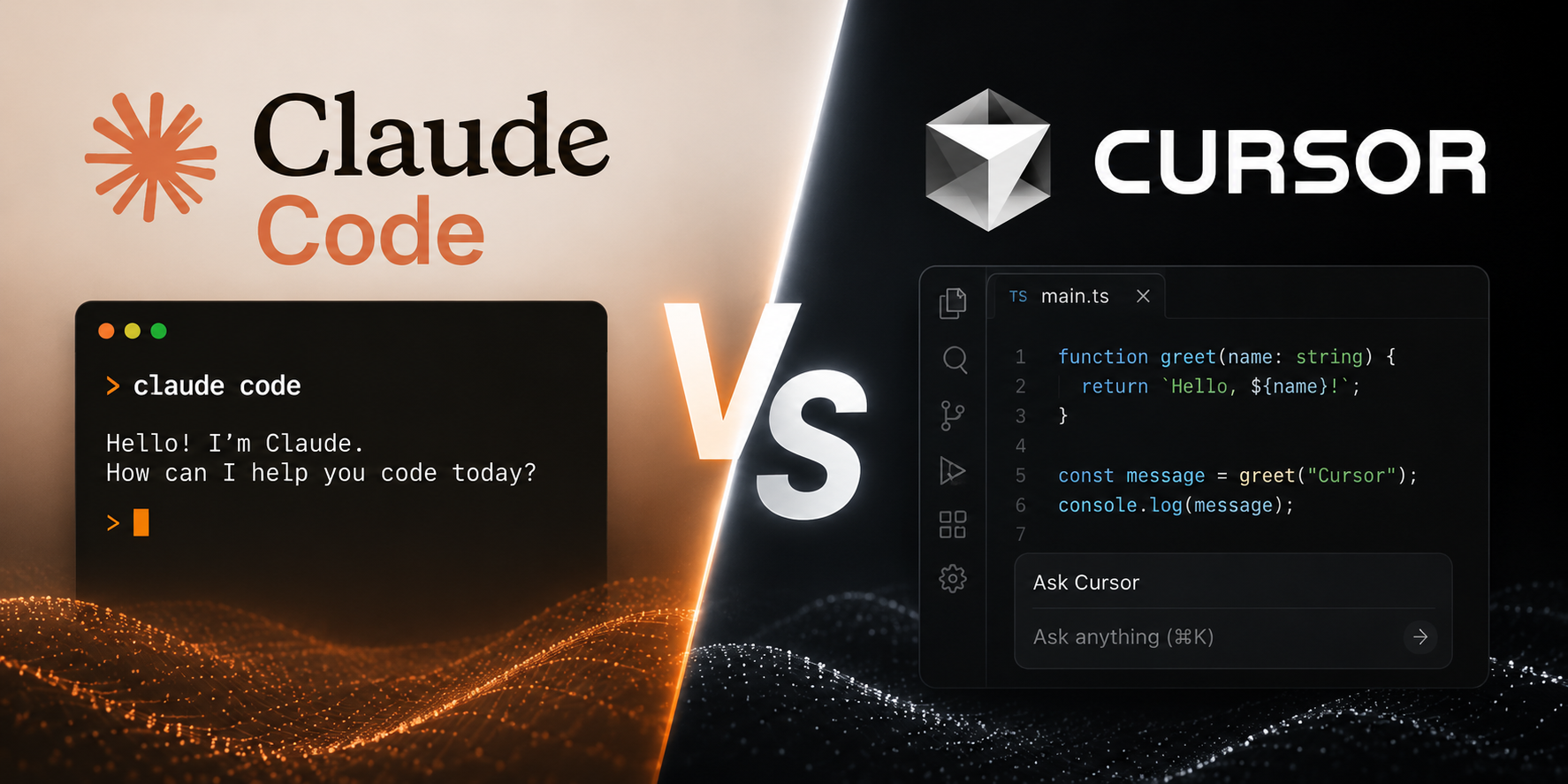
Claude Code vs Cursor (2026): The Definitive Comparison After the SpaceX Acquisition
SpaceX just acquired Cursor for $60B. Claude Code hits 95% on SWE-bench with Fable 5. The agentic era has a clear fault line — terminal harness vs IDE hard-fork. Here's every detail that matters.
The AI coding landscape split decisively in mid-2026. On June 16, SpaceX acquired Anysphere (the company behind Cursor) for $60 billion, marking the completion of Elon Musk's vertical integration strategy — compute, foundation model, and now the developer interface, all under one roof.
Meanwhile, Anthropic's Claude Code reached a 95% resolution rate on SWE-bench Verified using Claude Fable 5, setting a new industry benchmark for autonomous software engineering.
If you're choosing between these two tools in 2026, you're not just picking an editor preference. You're choosing an ecosystem, a philosophy, and a supply-chain bet.
The 30-Second Verdict
Choose Claude Code if: You need maximum agent autonomy, work in the terminal, trust the Anthropic/Google ecosystem, and want the highest SWE-bench accuracy for mission-critical tasks.
Choose Cursor if: You want a polished IDE experience, fast "vibe coding" with Composer 2.5, and the massive compute headroom of SpaceX's Colossus supercomputer backing your workflow.
---
Architecture: Two Fundamentally Different Philosophies
Cursor's Three-Layer Hard-Fork
Cursor is not an IDE plugin — it's a full VS Code fork. By modifying the editor core directly, it bypasses extension API limits and operates across three layers:
Layer 1 — The VS Code Fork: Direct control over the rendering pipeline enables speculative autocompletion and fluid inline diff-overlays impossible from an extension.
Layer 2 — AI Orchestration (Priompt): Uses the Priompt JSX library to compile prompts with priority scores and binary-search token pruning. Critical context (type definitions, core logic) is never lost when approaching model limits.
Layer 3 — Context Engine (Turbopuffer): Serverless vector search indexing codebases at over 1 trillion vectors, with semantic retrieval in under 10ms. AST-based segmentation via Tree-sitter keeps indexing nearly instantaneous.
Cursor also uses Merkle-tree synchronization to sync delta-diffs every five minutes — minimal local resource consumption with always-fresh context.
Claude Code's Agentic Loop
Claude Code operates as a terminal harness that cycles through three continuous phases:
1. Gather Context — Searches files, reads environment state, loads git history 2. Take Action — Edits code, executes shell commands autonomously 3. Verify Results — Runs test suites, validates outputs, creates file-snapshot checkpoints before every edit
The checkpoint system is significant: Claude creates undo states outside of git history, so you can roll back any change without touching your commit log. The CLAUDE.md file encodes project-specific conventions and is read at session start, giving the agent persistent context across sessions.
---
Performance: The Benchmark Gap That Matters
SWE-bench Verified scores as of June 17, 2026:
| Model | Score |
|---|---|
| Claude Fable 5 | 95.00% |
| Claude Opus 4.8 | 88.60% |
| Cursor Composer 2.5 | 79.60% |
The 15-point delta between Composer 2.5 and Fable 5 is the difference between a tool that handles routine tickets and one you can trust with mission-critical legacy refactoring. Cursor's Composer 2.5 is roughly 3× faster than standard frontier models and optimized for code retention — it's an excellent choice for high-throughput development. But for difficult reasoning tasks, Claude's high verification scores reflect a qualitatively different level of reliability.
---
Model Availability (June 2026)
| Claude Code | Cursor | |
|---|---|---|
| Frontier | Claude Opus 4.8, Sonnet 4.6 | GPT-5.5, Claude Sonnet 4.6, Gemini 3.1 Pro, Grok 4.3 |
| High-Accuracy | Claude Fable 5 | — |
| Speed-Optimized | — | Composer 2.5 |
Cursor's multi-model flexibility is a genuine advantage for teams that want to switch between providers. Claude Code offers depth rather than breadth — Fable 5 is the strongest single model available, but you're in the Anthropic ecosystem.
---
Pricing Breakdown
Claude Code Plans
| Plan | Price | Notes |
|---|---|---|
| Pro | $20/mo | Shared with Claude Chat — heavy coding depletes afternoon chat budget |
| Max 5× | $100/mo | 5× Pro usage, no peak-hour throttling |
| Max 20× | $200/mo | 20× Pro usage |
| Team | $20–125/seat | Mix of Standard and Premium seats |
Critical caveat: Claude Code and Claude Chat share the same usage pool. A heavy morning coding session will deplete capacity for afternoon research and chat.
Cursor Plans
| Plan | Price | Notes |
|---|---|---|
| Hobby | Free | Limited agent requests — evaluation only |
| Pro | $20/mo | Unlimited Tab completions + $20 monthly credit pool |
| Pro+ | $60/mo | 3× usage multiplier for premium models |
| Ultra | $200/mo | 20× multiplier |
Credit system note: "Auto Mode" is unlimited, but selecting premium models manually (e.g., GPT-5.5) draws from the dollar-equivalent credit pool. Claude Sonnet 4.6 depletes credits roughly 2× faster than Gemini 3.1 Pro.
Claude Code's Hidden Costs
Unlike Cursor's all-in-one managed environment, Claude Code's pricing ends at code generation. Production infrastructure costs sit outside Anthropic's billing:
- Cloud hosting (AWS/GCP/VPS)
- SSL certificates and managed DNS
- Managed databases and backend services
This is expected overhead for engineering teams but represents significant additional cost for solo practitioners.
---
Security and Compliance
In an agentic world, your AI tool is a privileged user with write access to your machine. The security implications are serious.
Cursor Privacy Mode
- Code context is never sent to external servers for training
- `.cursorignore` prevents sensitive files (`.env`, `.pem` keys) from entering the AI context window entirely
- ZDR (Zero Data Retention) governance on enterprise agreements
- No infrastructure in China — relevant for defense and compliance-heavy work
Claude Code Permission Modes
- Default: Explicit permission required for every file edit or shell command
- Auto-accept: Permits file edits and common filesystem commands (mkdir, mv) but gates all other terminal actions
- Plan Mode: Explore and propose changes without modifying source code
- Deletion Protection: Human verification required for any file deletion
Prompt injection risk — where agents read untrusted content from a website or extension and are tricked into executing malicious commands — is a top-tier security concern for both platforms. Neither is immune, but Claude's granular permission modes give more surface-level control.
Enterprise Compliance Checklist
- SOC 2 Type II: Both platforms verified
- HIPAA/PHI: Privacy Mode required on both
- ZDR: Available on high-tier enterprise agreements
- Data sovereignty: Cursor has no China infrastructure
---
The SpaceX Era: What the $60B Acquisition Actually Means
On June 16, 2026, SpaceX acquired Anysphere for $60 billion — merging the developer interface with the Colossus Supercomputer (1 million H100 equivalents) and the xAI (Grok) foundation model.
This changes the strategic calculus in three ways:
1. Compute reclamation: SpaceX's infrastructure leases with Anthropic and Google (worth ~$26B combined) contain 90-day termination clauses. SpaceX can redirect that compute to prioritize Cursor and Grok users, potentially compressing capacity available to Claude Code's underlying infrastructure partners.
2. Vertical integration: SpaceX now controls compute → model → development platform in a single stack. This enables pricing and performance optimizations that independent tool providers can't match.
3. Geopolitical positioning: Cursor's deliberate lack of China infrastructure aligns with SpaceX's broader positioning. For Western enterprise and defense work, this is a compliance advantage.
For CTOs, this forces a supply-chain decision: remain in the Anthropic/Google ecosystem or move into the SpaceX/xAI stack.
---
Feature Comparison
| Feature | Claude Code | Cursor |
|---|---|---|
| Interface | Terminal / CLI | VS Code hard-fork |
| Autocomplete | No | Excellent (speculative rendering) |
| Agent mode | Excellent | Excellent (Composer 2.5) |
| Multi-file editing | Excellent | Excellent |
| Repository indexing | File-based | Turbopuffer vector search (<10ms) |
| Context window | 200,000 tokens | Priompt-managed (priority pruning) |
| Terminal access | Native | Available |
| Git-aware operations | Native | Available |
| Model selection | Anthropic-only | Multi-model (GPT-5.5, Gemini, Grok, Claude) |
| Privacy mode | Permission-gated | .cursorignore + ZDR |
| Design Mode (visual prompts) | No | Yes |
| SWE-bench (best model) | 95% (Fable 5) | 79.6% (Composer 2.5) |
---
Real-World Task Performance
Large Repo Refactoring **Winner: Claude Code.** 200k context + Fable 5's reasoning handles cross-file architectural changes where Cursor's context pruning can lose thread.
Building New Features Daily **Winner: Cursor.** Speculative autocomplete, inline diffs, and the integrated editor experience means less context-switching during active coding sessions.
Debugging Production Issues **Winner: Tie.** Both tools perform well with sufficient context. Claude's agentic loop is better at autonomous diagnosis; Cursor's inline diff view is better for interactive debugging.
UI and Design Work **Winner: Cursor.** Design Mode translates visual prompts directly into UI code — Claude Code has no equivalent.
Security-Critical or Compliance Work **Winner: Depends.** Claude's granular permission modes give more control. Cursor's .cursorignore and no-China-infrastructure posture are stronger for regulated industries.
---
Who Should Use Each Tool
Choose Claude Code if: - Your workflow is terminal-centric - You manage large, complex production codebases - Mission-critical accuracy matters more than speed (Fable 5 at 95%) - You're in the Anthropic/Google supply chain and want to stay there - You value granular permission control for security compliance
Choose Cursor if: - You live inside VS Code and want AI deeply embedded there - You want the fastest "vibe coding" experience via Composer 2.5 - You need multi-model flexibility across GPT-5.5, Gemini, Grok, and Claude - You want the SpaceX compute backing and the upside of vertical integration - You build UI-heavy products where Design Mode adds real value
---
Final Verdict
The 2026 choice between Claude Code and Cursor is no longer a simple IDE-vs-terminal preference — it's a strategic ecosystem decision.
Claude Code wins on raw benchmark performance and autonomous engineering depth. The 95% SWE-bench score with Fable 5 is industry-leading, and the terminal-native agentic loop genuinely feels like delegating to a senior engineer rather than prompting an assistant.
Cursor wins on developer experience, model flexibility, and the sheer compute scale that comes with the SpaceX acquisition. For teams building product fast in a VS Code environment, Composer 2.5 combined with the polished IDE workflow is hard to argue with.
The most important factor isn't tool quality — both are excellent. It's which supply chain you trust over the next 24 months.
Use our compare page to line up Claude Code, Cursor, and other plans side by side.